Showing posts with label PWC Safety. Show all posts

Tuesday, 1 March 2016

EVERYTHING PERSONAL WATER CRAFT (PWC)


Personal Watercraft (PWC)

Why are Personal Watercrafts treated differently to normal powerboats?
A personal watercraft is unlike most powerboats because of the following: it has a fully enclosed hull, does not retain water taken on if it capsizes, and is designed to be operated by a person standing, sitting astride or kneeling on the vessel, but not seated within the vessel. They also do not have a skeg and prop, which can help slow down a normal powerboat and also limits a normal powerboat to a certain depth of water.

Why are there more restrictions on PWC than other power boats?
While the majority of riders do the right thing, it is public concern over the behaviour of a minority of riders that has led to some of the restrictions currently in place. So it is up to us all to be safe and responsible.

What is a PWC Exclusion Zone?
A PWC "Exclusion Zone" means the waters you are not permitted to drive a PWC are in the Exclusion Zone at any time.

What is a PWC Restriction Zone?
A PWC "Restriction Zone" means the waters you are not permitted to use a PWC for 'irregular driving' within 200 metres of a river bank or shore when you're in the Restriction Zones.

What is 'irregular driving'?
It is a term used to describe when you drive a PWC in a circle or other pattern or weaving or diverting, or surfing down or jumping over or across, any swell, wave or wash. You should operate a PWC generally in a straight line within 200 metres of the shoreline.

Why is noise such a big deal?
One of the most common complaints received about PWC is noise. This tends to happen when riders congregate near residential or popular recreational areas and drive around repeatedly in the same area. Simply put, it can aggravate other people. If you’re driving a PWC, you should always be considerate, particularly when it’s early in the morning as noise travels a long distance in calm conditions. Also when winds are blowing towards residential areas, the noise travels there too. You need to take care in environmentally sensitive areas. It’s best not to drive your PWC continuously close to residential, picnic or recreation areas.


Maintenance and fuelling

It’s important to always keep your PWC in good order. You can do this by regularly checking the main features before you leave home, the ramp, mooring or wharf. The major causes of breakdown are engine failure, fuel shortage or contamination, mechanical failure and battery failure.

Maintenance checklist

  • Check your registration number
  • Look at your steering control – make sure it’s working properly.
  • Check your fuel and oil supplies. Top up if necessary.
  • Make sure your engine compartment is adequately ventilated. Simply sniff for fumes before you try to start your engine.
  • Look for any leaks in fuel lines, fuel or oil tanks or the exhaust system.
  • Check your batteries. Make sure the terminals are safely secured and properly charged with fluid at proper levels.
  • Check your engine hood cover is latched securely.
  • Make sure the pump/intake area is free of debris.
  • Look for cracks and other damage to the hull.
  • Test the throttle. Make sure that it is in proper working order.
  • Check that the lanyard cut-off switch is in proper working order and that it is attached to your wrist or your lifejacket.
  • Make sure you have enough rope for mooring and towing.
  • Check your choke and fuel reserve controls.
  • Keep the hull free of damage, algae and other growth.
  • Be sure your engine is free of grease and oil build-up, and that it’s properly tuned.

Fuelling

It’s important that you fuel your PWC on land. Not only is fuel dangerous, it’s also a significant source of water pollution. Be aware of overfilling – fill the tank slowly so you avoid a spill. Watch the vents and use absorbent material to collect any overflow. Also, be sure not to put those materials into the PWC or the water.

PWC safety tips

There are some key safety tips for you to remember when you hit the water on your PWC.
  • You should always wear your lifejacket.
  • You should always wear a safety lanyard attached to your wrist or lifejacket and to the PWC’s lanyard terminal so that it will stop the engine if you fall off.
  • Relax when you ride. Do not ride with your elbows locked. Bend your arms and knees slightly when you ride to allow for any swells and wakes.
  • Do not cut blind corners.
  • Use your mirror and check over your shoulder before turning.
  • You must travel on the right hand side particularly on narrow waterways and slow down.
  • If your PWC has a watertight compartment, it may be useful to carry items such as sunscreen, water, a flash light and a mobile phone.
  • You must obey any speed limits and restrictions that may be in force. Be sure to follow the nautical rules.
  • Keep a lookout at all times and always look behind you before you turn. Be aware that swimmers may be obscured behind the swell, waves and wake.
  • You should always go easy on the drink – waves, wind and weather multiply the effects of alcohol. One third of all boating fatalities involve alcohol. Never ride your PWC under the influence of alcohol or drugs.
  • If you experience difficulty with your PWC, return to shore. If this isn’t possible then stay with your PWC and do not attempt to swim to shore. A PWC is easier for rescuers to see than a person in the water.
  • Make sure you exercise care, courtesy and common sense. Make your ride enjoyable for everyone.
  • Keep an eye on the weather for any change in conditions.
  • Make yourself a better and safer rider and familiarise yourself with the way your PWC handles.
  • Irregular riding carries a host of risks. You may forget to be aware of traffic in the vicinity of your vessel, or misjudge speed and distances off. Remember – care, courtesy and common sense on the water.
  • You should never allow anyone to place their hands, hair or feet near the jet pump intake and always keep clear of the jet nozzle and never allow jet thrust to enter any of your body cavities. It can cause you severe injury
  • Wake or wave jumping is not recommended by most PWC manufacturers because of the possibility of back injuries.

Boarding and re-boarding

When you’re boarding or re-boarding from the water, always make sure you approach your PWC from behind. Pull yourself carefully aboard, making sure to keep your weight centered on the boat. It’s a good idea to practice getting off and re-boarding in progressively deeper water. Do this close to the shore until you are always able to re-board when you can’t stand on the bottom.
Remember to reconnect the lanyard in order to start the engine.
""

Falling off

If you fall off a PWC, the lanyard will disconnect once you enter the water. This will shut down the PWC’s engine and make it stop. You’ll find some older PWC have an automatic idle and self-circling capacity. If you fall off, the PWC will circle slowly in the water until you can re-board. In either case, swim to your PWC, re-board carefully at the stern, reattach the lanyard and re-start your engine.
Remember: Keep a close eye on your surroundings and other vessel traffic that may be in the area.
If your PWC has stalled and won’t restart, don’t attempt to swim to shore. You should stay with your PWC as you’ll be easier to spot by rescuers.
If you have a passenger that falls off a PWC, it’s best you slow down immediately. Manoeuvre the PWC, taking care not to hit the person in the water. Warn oncoming vessels and approach the person in the water from downwind or in the current. When you’re trying to pick the person up, make sure you turn off the engine or place the it in neutral.

Steering


 You’ll find most PWC have a steerable nozzle at the stern through which water is forced, and helping to propel the boat. The direction in which the nozzle is aimed is controlled by the handlebar or steering wheel. The nozzle is located at the aft end of the pump housing and the direction that it is pointed controls the direction of the exiting water. You should refer to your PWC owner’s manual for more specific operating instructions.
 
For steering control, power to the pump must be maintained. If the engine is allowed to idle or shut down during a turn, you’ll lose all power and the PWC will continue to move in the same direction, regardless of any movement of the steering controls. If you back off the throttle, the steering capability of the PWC will lessen. Make sure you give yourself plenty of room and be aware of your surroundings at all times.
Some newer PWC models have off - throttle steering capabilities, which will give you enough thrust for steering when the throttle is reduced.
 
Others will drop rudders into the water if the jet has been idle for a certain length of time. Again, you should refer to your PWC manual to determine whether your PWC has these capabilities.
All PWC are equipped with a safety ignition cut off key called a lanyard, which is designed to stop the engine if you fall off your PWC. Lanyards are an important safety device, which can be attached to the your wrist when you’re operating the PWC or, in some cases, your lifejacket.


Noise and pollution


You should always be considerate when it comes to noise, particularly at these times:
- Early in the morning (noise travels further in calm conditions)
-When winds are blowing towards residential areas.
Noise can be annoying not only because of its level, but also because of the type of noise being created. It is important that you consider the effects of your activities on those surrounding you and on the local residents.
Even if your vessel is relatively quiet, it becomes offensive noise if you run it early in the morning or stay too long in the same area. The less number of complaints you get, the greater your chance to enjoy the sport.
You should be aware that it’s an offence to deliberately discharge garbage, oil and other waste into the aquatic environment. If you do so, you will be penalized.

Take it easy

PWC have a number of performance and handling characteristics that set them apart from other small powered vessels. They are very powerful for their size, nearly always propelled by a water jet rather than propellers, are highly manoeuvrable and can operate in quite shallow water.
PWC can also be more difficult to handle in a ‘close quarters’ situation than other powered vessels, due to a lack of off-throttle steerage and, for many older models, no reverse thrust or braking method. These are some of the reasons PWC are subject to a number of specific requirements governing their licensing and use.


Equipment

Personal watercraft are designed to operate in a wide range of conditions, from flat water to surf. The nature of PWC riding means you can get quite wet and when it comes to equipment, there are some items that need consideration.
  • Lifejackets – whether you’re the operator or a passenger, you must always wear an appropriate lifejacket
  • Safety lanyard – you must have one. It automatically cuts off the power if you fall off
  • Wetsuit – they keep you warm and can help you float
  • Helmet – not compulsory but work considering for additional head protection
  • For equipment specific to tow-in surfing


Towing from a PWC

                                 
   PWC can be great fun and when used responsibly they provide an exhilarating way to enjoy our waterways. A PWC is a ‘vessel’ and, like other powercraft, the operator is responsible for the safe use of the craft and the safety of those onboard or being towed.
While a PWC may be limited in general towing capabilities when compared with dedicated tow vessels such as wakeboard boats, a PWC does however provide a unique ability to operate in surf zones and that is why they are used for tow-in surfing. Regardless of where a PWC is used, it is necessary to observe the rules and regulations for safety navigation, and to apply care, courtesy and common sense.

Driver and observer

When you’re boating and doing tow sports, the driver and observer need to work as a team. As a driver you keep lookout ahead and also control the boat. As an observer, you face backwards and keep an eye on the person being towed and any craft approaching from behind. When you’re observing, you tell the driver if there are any issues.
If you’re towing from a PWC, you still need to have an observer. The guidelines for an observer are the same, no matter what type of craft.
If you’re driving, you must:
  • hold a valid Boaters Card 
  • be responsible for the safety of the boat and the towed people
  • be aware of, and keep, the minimum distances-off that apply to boat and the people being towed
  • know all the standard hand signals
  • not be under the influence of alcohol or drugs

If you’re observing, you must:

  • observe the towed people and report any issues to the driver
  • tell the driver about any craft approaching from behind
  • know all the standard hand signals
  • not have hearing, sight or other disabilities that could affect their capacity to observe
  • not be under the influence of alcohol or drugs.
When you’re towing, the observer faces backwards to watch the people being towed while the driver faces forward and looks out ahead.


To guarantee access to all of  Boat Nut Magazine articles, pictures and featured services visit the official Boat Nut Magazine ©™ website. Be sure to reply to the Boat Nut Association registration on our site for the latest Boat Nut weekly and monthly news letters and opportunities.


Copyright 2015 © Boat Nut Media, Toronto, Ontario. All rights reserved. No part of this information/publications may be stored in a retrieval system, transmitted, or reproduced in any way, including but not limited to photocopy, magnetic, or other record, without prior agreement and written permission of the publisher, Boat Nuts Media ©™ No liability is assumed with respect to the information provided

Friday, 15 January 2016

Some sobbering numbers for you Canadian PWC Owners


 http://boatnutmagazine.com/

 
PWC Stats in Canada, will the numbers of injuries be reflected by the number of PWC's in the market? There are now an estimated 60,000 PWC in Ontario alone and these numbers are growing every month. Is it time to consider something other than a boaters card, I am not a fan of over regulation however these machines are faster and more dangerous than ever.


Figures from RED CROSS


There were 68 fatalities involving personal watercraft (PWC) during 1991-2008, including

33 immersions and 35 trauma deaths (Tables 3a). Traumatic incidents frequently resulted

in head injury, which contributed to at least 32% of PWC trauma deaths. Other injuries

included spinal injury in 18%, fractures in 12%, and major lacerations in 26%. Victims often
sustained multiple injuries

Overall, 19% (13/68) had head injuries, 10% (7/68) spinal injuries, and 16% (11/68)
major lacerations. This compares with 4% (67/1,788) head injuries for other powerboats

and 2% (17/979) for unpowered boats; 1% (11/1,788) spinal injuries for other
powerboats and 0% for unpowered boats; and 2% (28/1,788) major lacerations for

other powerboats and 1% (5/979) for unpowered boats.

PURPOSE

 96% of PWC victims died during recreational activities, 1% during occupational

activities and 3% during other/unknown activities . Only recreational

fatalities will be discussed here.


RECREATIONAL FATALITIES


There were 65 recreational fatalities involving PWC, including 31 immersion deaths and

34 trauma deaths (including 3 cases where the person was being towed by a PWC). PWCs

accounted for 1% of all immersion deaths, 2% of powerboat immersion deaths, 25% of all

trauma deaths and 28% of powerboat trauma deaths

Given the small number of immersion fatalities and the large proportion of trauma victims,

this section will combine discussion of immersion and trauma deaths.


TYPE OF INCIDENT

 
 Overall, 34 victims died following a collision (52%), 21 fell overboard

(32%), 4 capsized (6%), 1 was swamped (2%), 1 had other causes (2%); circumstances were

unknown for the remaining 4 victims (6%). Immersion deaths most often resulted from

falling overboard, while nearly all trauma deaths resulted from collision. 65% of PWC

collisions involved another boat, whereas for other powerboats, only 29% of collisions

involved another boat.

28

PERSONAL FACTORS


AGE & SEX


 Males accounted for 85% of PWC fatalities during 1991-2008, with those

15 to 24 years at highest risk for both immersion and trauma. Females and children were

overrepresented in PWC trauma deaths. While females accounted for only 3% of PWC

immersion deaths, they represented 26% of trauma deaths; similarly, children under 15

accounted for only 6% of immersion deaths but for 18% of trauma deaths.

ALCOHOL


 Alcohol was present or suspected for 51% of PWC victims 15 years of age and

older, possibly more since alcohol was unknown in 7% of cases. Alcohol was present or

suspected in a higher proportion of immersion deaths than of trauma deaths.

SWIMMING ABILITY


 Swimming ability was unknown for 74% of PWC victims. For the


remainder,


 35% were weak or non swimmers, 29% were average or strong swimmers and

35% were swimmers of unspecified ability.


BOATING EXPERIENCE


 Boating experience was unknown for 60% of PWC victims. For the

remainder, 38% were experienced boaters, 58% inexperienced and 4% occasional boaters.

In comparison, only 7% of powerboat victims for whom boating experience was known

were inexperienced boaters.

ETHNICITY


 Although aboriginal peoples were over-represented in most categories of

water-related fatality, they accounted for only 3% of PWC fatalities, roughly equivalent to

the proportion they represent of the Canadian population.


EQUIPMENT FACTORS


FLOTATION


 26% of immersion victims were properly wearing a flotation device

, while 50% of trauma victims were doing so.


ENVIRONMENTAL FACTORS


BODY OF WATER


 68% of fatalities occurred in lakes, 20% in rivers, 9% in the ocean, 2% in

other locations, and 2% in an unknown location .

WIND AND WAVES


 Wind conditions were unknown for 80% of fatalities. For the remainder,

wind was described as strong for 8%, breezy for 54% and calm for 38%. Wave conditions

were unknown or other for 71% of victims. For the remainder, it was rough for 16%,

choppy for 37%, calm for 42% and other for 5%; no stormy weather was reported
.


LIGHT CONDITIONS


8% of PWC fatalities occurred in darkness, 12% in twilight, and 72%

in daylight. Light conditions were unknown for 8% of deaths..


MONTH AND DAY


 All fatalities occurred between April and October, 97% between

May and September. July and August accounted for 65% of deaths, compared with 33%

for other powerboats and 30% for unpowered boats. 71% of deaths took place between

Friday and Sunday.

REGION


 The highest proportion of PWC fatalities were seen in Quebec and Ontario,

followed by the Prairie provinces and British Columbia. There were no PWC deaths

identified in the northern territories during 1991-2008, but there were 6 immersion deaths

in NWT where the type of boat was unknown .

ACCOMPANIMENT


14% of PWC victims were alone, while 60% were accompanied by at least

one adult, 9% only by minor(s) and 11% by someone of unknown age; an adult bystander

was present in 6% of cases.


TEMPERATURE*


WATER TEMPERATURE


Water temperature was unknown for 71% of PWC immersion fatalities.

For the remainder, it was reported to be extremely cold (<10°C) for 44%, cold or cool

(10-20°C) for 33%, and warm or hot (>20°C) for 22% .


 AIR TEMPERATURE


 Air temperature was unknown for 77% of PWC immersion deaths.

For the remainder, it was 15°C for 29%, and >15°C for 71% .

ICE AND COLD WATER

 Based on the criteria used in Module 2 of the 1991-2000 series (Ice &

Cold Water), it is probable that cold water was a factor in 16% of PWC immersion deaths.


SALES NUMBERS FROM NMMA 2015


The NMMA reports that retail sales of new boats and engines reached $2.1 billion in 2015, a 3.8 percent increase over 2014 while pre-owned boat sales totaled $1.06 billion, maintaining the industry’s healthy contribution to the Canadian economy. In addition, personal watercraft, including brands such as Jet Ski, SeaDoo and WaveRunner, experienced a sales surge in 2015 with unit sales of new personal watercraft jumping ten percent from 2014. The pre-owned category also experienced a strong increase in 2015, rising seven percent. What’s more, Canadians’ participation in recreational boating has remained stable at 43 percent of the adult population, up from 35 percent in 2011-2012, the last time it was recorded.


The bottom line is that the numbers from Red Cross will be a direct reflection of the volume of PWC's in the market. So Please be carful on the water!

 
Copyright 2015 © Boat Nut Media, Toronto, Ontario. All rights reserved. No part of this information/publications may be stored in a retrieval system, transmitted, or reproduced in any way, including but not limited to photocopy, magnetic, or other record, without prior agreement and written permission of the publisher, Boat Nuts Media ©™ No liability is assumed with respect to the information provided

Wednesday, 1 April 2015

Knowing PWC's


http://boatnutmagazine.com/

PWC  do you know the rules, regulations and safety requirements?


What is a PWC? Surprisingly enough we hear this question asked ALL the time. A PWC is a personal watercraft, also known as a jet ski, or in some parts of the world a water scooter. Do not get confused Sea doo's, Waver runners, and Jet Ski's are all personal watercraft the only difference is who the brand name is trade marked too. With Sea doo a lot of people get confused as Sea Doo also builds and markets jet boats. Sea doo PWC's are not a 'BOAT per say they are very similar to every other brand on the market. All PWC's are stand or sit 13 foot or less vessels, running on an inboard engine which propels a jet pump. Do not let yourself be confused or swayed into believing a boat and a PWC are one in the same and if one can drive a boat one can properly run a PWC or vice versa.

Different Brands of PWC:

↪Jet Skis trademarked by Kawasaki
↪Sea Doo trademarked by Sea Doo
↪WaveRunner trademarked by Yamaha


PWC's do have a lot of benefits for new or experienced boaters. They are affordable, easy to transport, fairly easy to maintain (if you know how to do this properly), they are great for water sport, socializing, and cruising the waterways. Although despite how popular and fun these vessels can be the lack of safety preparation and knowledge of laws and regulations to operate one are still highly ignored or unknown. Of course in a lot of cases the legal guidelines vary from state to state or country to country, however safety equipment requirements remain the same. So we recommend if you have or are looking into buying a PWC you take the time and look up your areas requirements for operation. The guidelines set forth by your government or Coast Guard NEED to be legally and respectfully followed.


Canadian requirements for PWC operators
• Must be over 16 years of age to operate PWC, no exceptions.
• Hold a valid approved PCOC, and have on your persons when operating vessel.
• Have at least the Minimum CCG approved safety equipment on board.
• Have valid registration/insurance.

However these regulations and age requirements do not apply in the Northwest Territories or Nunavut. Which personally I think is absurd.

CCG minimum required safety equipment
• CG approved PFD for all persons operating or on board. Fit to size and weight.
• 1 buoyant heaving line NO less then 15m.
• CG approved flares or waterproof flashlight.
• A proper, approved and functioning sound signaling device.

Boat Nut Media would advise for all boaters and PWC operators, especially when going out alone, inexperienced, or on unfamiliar waterways to always invest and keep an AIS device with you. Most AIS devices (Automatic Identification System) are equipped with both flashing strobe lights for higher visibility, and GPS for a more accurate location. When activated your AIS will transmit to all AIS equipped vessels in the area, this can certainly increase your chances of receiving quick accurate assistance.


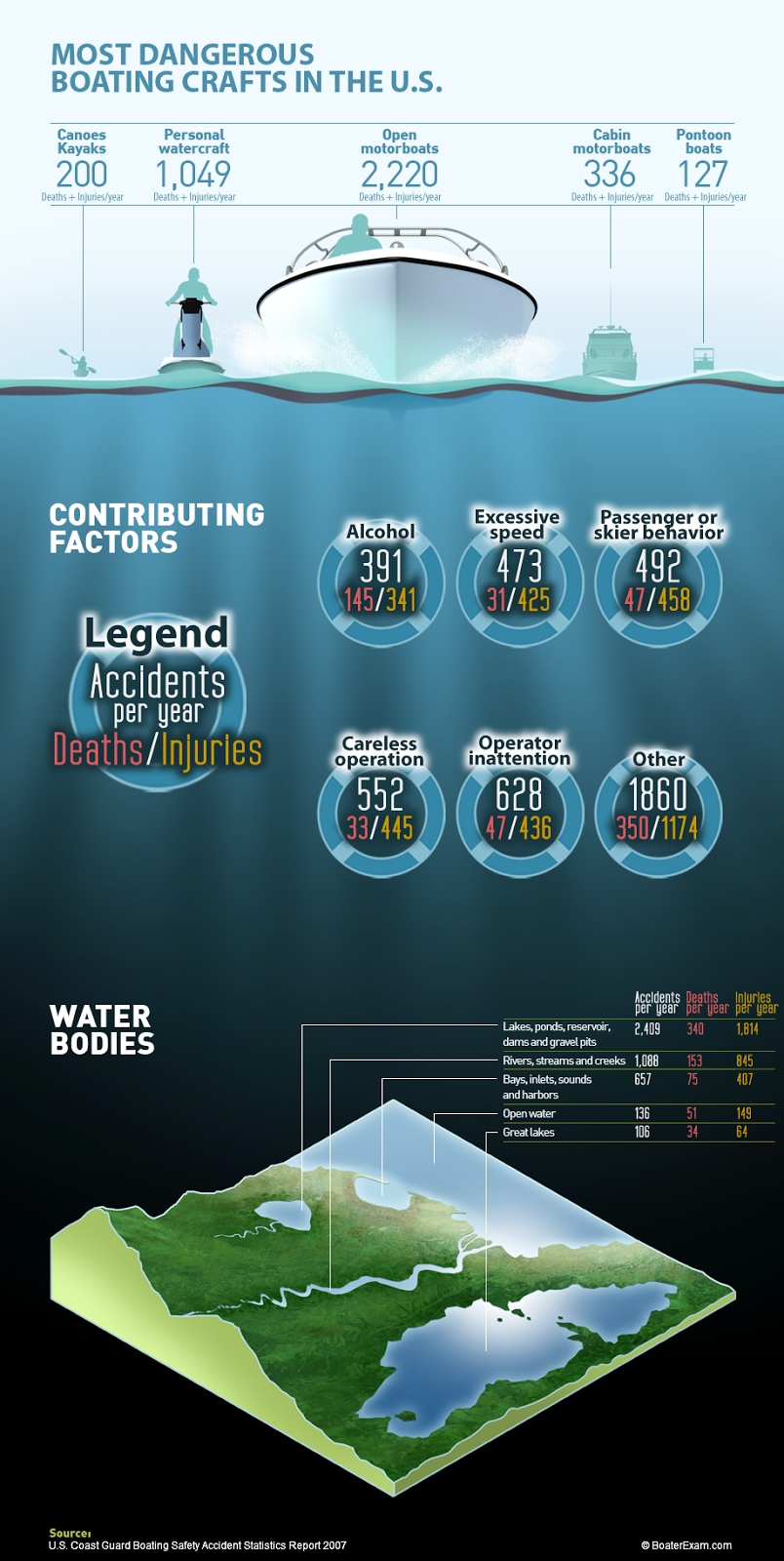
With over a million PWC's registered in both Canada, and the United states its safe to say there is a strong market for these vessels, but as with any popular market comes many risks. The statistic's of marine related accident's as whole is quite disturbing, but when you think about half of marine related incidents happen on PWC's and there are triple the amount of registered Boats on the water, this should be a clear sign safety is not taken as seriously as it should be. Just taking a look at the USDOT statistics shows us that over 3,200 PWC accidents a year are reported, with over 1,500 of those accidents resulting in injured persons, and almost 70 of those ending in fatalities. The USCG also reports that per 4,000 accidents close to 2,500 of these are due to collisions with other vessels. The sad part is with more boaters and PWC operators being more observant and taking less risk's this number could drastically come down instead of increasing. So why do so many PWC accidents occur? How can these accident's be avoided? Well first obviously like every other motorized piece of equipment, accident's happen, things fail, things can be hit, on a jet engine sucked up, and people will still always take risks no matter how illegal or insane it may be.


Common reason's why accident's occur on PWC's and ways to help prevent them:
↪Low visibility and high speeds. PWC are much smaller then a lot vessels on the water which makes them hard to be seen by other boaters. When you combine this with no direct routes, and high speeds both with boats and PWC's accidents happen quite often. Being aware that PWC's and other boats on the water can change direction at any moment and it is extremely hard to judge where and how fast the boats around you are going paying close attention to marine traffic on the water is highly, highly advised. It is important to remember your PWC does not have navigation lights or an anchor light so in low light or bed weather you will be the last vessel to be seen on the water. If the lake has the right conditions and you are riding a white PWC you can blend in with the white caps, and at higher speeds this is a serious issue!
Be observant! Especially on PWC, operators are usually out for the thrill and the fun of it. Somewhere in between keeping up with your buddies, or looking for the next good wake a lot of times you fail to keep your surroundings in mind. Always be aware of your environment, what's around and below you,  what area are you in, is there a lot of traffic, how close to shore are you, all of these are important to know at any given time.
Dangerous maneuvering is never advised and should always be avoided. What would be considered dangerous maneuvering? Sharp, or high speed turns, taking unnecessary risks, or weaving in between marine traffic. Speeding through no wake zones, by moored or anchored vessels, buoys, during dangerous sea conditions, or around high risk environments (i.e. low depths, rocks, lines in water, ext.). Jumping or following a boaters wake, this always seems like a fun idea at the time! It is never advised to follow in the path of a boater, jump, steer, or run up on a boaters wake. There are multiple reason's for this you can hit the wake to hard or at the wrong angle which can end in sever injuries, or accidents. Also the boater may not be paying attention and see you following them and if the make a sharp turn, or slow down and your not paying attention or are to close you can literally run your PWC right into the back or side of the boat. PWC's are agile, maneuverable, and quick, doing twists and turns, pulling 180-degree turns, and jumping large wakes can be a lot of fun! However also makes it impossible for another boater to judge what the jet skier will do next. All boaters should also keep in mind, knowing how to swim and having a PFD on does not mean hitting the water will be safe. At high speeds or wrong angels, hitting the water can feel and be very much like hitting concrete.
Allowing inexperienced boaters or children to go out by themselves on PWC's. If you are going to allow inexperienced boaters, or younger individual(s) to take out your PWC remember your vessel should have come with two keys, one for full horsepower, and another for learning and lower horsepower. Never give the full key to a child or someone inexperienced. PWC can not be steered with out throttle which causes a lot of people to quickly increase speed especially at start shot and this can be very dangerous. Also always go over safety procedures, equipment, and how the vessel will respond and preform. It is always a risk to let people use your PWC but by informing them a much as possible is always best. NEVER let someone take out a PWC under the age of 16 or legal requirements, who can't swim, or who does not have a proper fitting PFD!

Boat Nut Media will be launching an 'Introduction to boating, PWC operating and safety course'. Our course will be covering everything from laws and regulations, safety requirements and equipment. We will also be to teach you basic maintenance, the pro's and con's to mooring or docking your vessel overnight, and the differences and benefits to the different keys you will receive with your PWC.

Introduction to Personal Water Craft/ PWC Program 2015:

Personal Water craft are versatile, fun and exhilarating craft, Boat Nut proficiency course prepares you for riding safely and responsibly and is designed for first time and experienced riders alike.

Objective: To be self sufficient in good conditions and aware of the limitations of yourself and PWC.

Ashore Knowledge: Safety, Seaman Ship, Weather, Navigation, Complementary Water Sports Guidelines. This part of the program contains 44 separate topics that are related to the above list.

Afloat Skills: Preliminaries, Maneuvering, Under Power, Making Fast and Snugging Down. This part of the program contains 16 separate topics related to the above list.


This program when completed can be used as a prerequisite for the International Certificate of Competency which is commonly required when operating your own or renting a personal water craft abroad. Boat Nut considers this program the most comprehensive in Canada.


To guarantee access to all of  Boat Nut Magazine articles, pictures and featured services visit the official Boat Nut Magazine ©™ website. Be sure to reply to the Boat Nut Association registration on our site for the latest Boat Nut weekly and monthly news letters and opportunities.


Copyright 2015 © Boat Nut Media, Toronto, Ontario. All rights reserved. No part of this information/publications may be stored in a retrieval system, transmitted, or reproduced in any way, including but not limited to photocopy, magnetic, or other record, without prior agreement and written permission of the publisher, Boat Nuts Media ©™ No liability is assumed with respect to the information provided.