Showing posts with label watercraft. Show all posts

Tuesday, 1 March 2016

EVERYTHING PERSONAL WATER CRAFT (PWC)


Personal Watercraft (PWC)

Why are Personal Watercrafts treated differently to normal powerboats?
A personal watercraft is unlike most powerboats because of the following: it has a fully enclosed hull, does not retain water taken on if it capsizes, and is designed to be operated by a person standing, sitting astride or kneeling on the vessel, but not seated within the vessel. They also do not have a skeg and prop, which can help slow down a normal powerboat and also limits a normal powerboat to a certain depth of water.

Why are there more restrictions on PWC than other power boats?
While the majority of riders do the right thing, it is public concern over the behaviour of a minority of riders that has led to some of the restrictions currently in place. So it is up to us all to be safe and responsible.

What is a PWC Exclusion Zone?
A PWC "Exclusion Zone" means the waters you are not permitted to drive a PWC are in the Exclusion Zone at any time.

What is a PWC Restriction Zone?
A PWC "Restriction Zone" means the waters you are not permitted to use a PWC for 'irregular driving' within 200 metres of a river bank or shore when you're in the Restriction Zones.

What is 'irregular driving'?
It is a term used to describe when you drive a PWC in a circle or other pattern or weaving or diverting, or surfing down or jumping over or across, any swell, wave or wash. You should operate a PWC generally in a straight line within 200 metres of the shoreline.

Why is noise such a big deal?
One of the most common complaints received about PWC is noise. This tends to happen when riders congregate near residential or popular recreational areas and drive around repeatedly in the same area. Simply put, it can aggravate other people. If you’re driving a PWC, you should always be considerate, particularly when it’s early in the morning as noise travels a long distance in calm conditions. Also when winds are blowing towards residential areas, the noise travels there too. You need to take care in environmentally sensitive areas. It’s best not to drive your PWC continuously close to residential, picnic or recreation areas.


Maintenance and fuelling

It’s important to always keep your PWC in good order. You can do this by regularly checking the main features before you leave home, the ramp, mooring or wharf. The major causes of breakdown are engine failure, fuel shortage or contamination, mechanical failure and battery failure.

Maintenance checklist

  • Check your registration number
  • Look at your steering control – make sure it’s working properly.
  • Check your fuel and oil supplies. Top up if necessary.
  • Make sure your engine compartment is adequately ventilated. Simply sniff for fumes before you try to start your engine.
  • Look for any leaks in fuel lines, fuel or oil tanks or the exhaust system.
  • Check your batteries. Make sure the terminals are safely secured and properly charged with fluid at proper levels.
  • Check your engine hood cover is latched securely.
  • Make sure the pump/intake area is free of debris.
  • Look for cracks and other damage to the hull.
  • Test the throttle. Make sure that it is in proper working order.
  • Check that the lanyard cut-off switch is in proper working order and that it is attached to your wrist or your lifejacket.
  • Make sure you have enough rope for mooring and towing.
  • Check your choke and fuel reserve controls.
  • Keep the hull free of damage, algae and other growth.
  • Be sure your engine is free of grease and oil build-up, and that it’s properly tuned.

Fuelling

It’s important that you fuel your PWC on land. Not only is fuel dangerous, it’s also a significant source of water pollution. Be aware of overfilling – fill the tank slowly so you avoid a spill. Watch the vents and use absorbent material to collect any overflow. Also, be sure not to put those materials into the PWC or the water.

PWC safety tips

There are some key safety tips for you to remember when you hit the water on your PWC.
  • You should always wear your lifejacket.
  • You should always wear a safety lanyard attached to your wrist or lifejacket and to the PWC’s lanyard terminal so that it will stop the engine if you fall off.
  • Relax when you ride. Do not ride with your elbows locked. Bend your arms and knees slightly when you ride to allow for any swells and wakes.
  • Do not cut blind corners.
  • Use your mirror and check over your shoulder before turning.
  • You must travel on the right hand side particularly on narrow waterways and slow down.
  • If your PWC has a watertight compartment, it may be useful to carry items such as sunscreen, water, a flash light and a mobile phone.
  • You must obey any speed limits and restrictions that may be in force. Be sure to follow the nautical rules.
  • Keep a lookout at all times and always look behind you before you turn. Be aware that swimmers may be obscured behind the swell, waves and wake.
  • You should always go easy on the drink – waves, wind and weather multiply the effects of alcohol. One third of all boating fatalities involve alcohol. Never ride your PWC under the influence of alcohol or drugs.
  • If you experience difficulty with your PWC, return to shore. If this isn’t possible then stay with your PWC and do not attempt to swim to shore. A PWC is easier for rescuers to see than a person in the water.
  • Make sure you exercise care, courtesy and common sense. Make your ride enjoyable for everyone.
  • Keep an eye on the weather for any change in conditions.
  • Make yourself a better and safer rider and familiarise yourself with the way your PWC handles.
  • Irregular riding carries a host of risks. You may forget to be aware of traffic in the vicinity of your vessel, or misjudge speed and distances off. Remember – care, courtesy and common sense on the water.
  • You should never allow anyone to place their hands, hair or feet near the jet pump intake and always keep clear of the jet nozzle and never allow jet thrust to enter any of your body cavities. It can cause you severe injury
  • Wake or wave jumping is not recommended by most PWC manufacturers because of the possibility of back injuries.

Boarding and re-boarding

When you’re boarding or re-boarding from the water, always make sure you approach your PWC from behind. Pull yourself carefully aboard, making sure to keep your weight centered on the boat. It’s a good idea to practice getting off and re-boarding in progressively deeper water. Do this close to the shore until you are always able to re-board when you can’t stand on the bottom.
Remember to reconnect the lanyard in order to start the engine.
""

Falling off

If you fall off a PWC, the lanyard will disconnect once you enter the water. This will shut down the PWC’s engine and make it stop. You’ll find some older PWC have an automatic idle and self-circling capacity. If you fall off, the PWC will circle slowly in the water until you can re-board. In either case, swim to your PWC, re-board carefully at the stern, reattach the lanyard and re-start your engine.
Remember: Keep a close eye on your surroundings and other vessel traffic that may be in the area.
If your PWC has stalled and won’t restart, don’t attempt to swim to shore. You should stay with your PWC as you’ll be easier to spot by rescuers.
If you have a passenger that falls off a PWC, it’s best you slow down immediately. Manoeuvre the PWC, taking care not to hit the person in the water. Warn oncoming vessels and approach the person in the water from downwind or in the current. When you’re trying to pick the person up, make sure you turn off the engine or place the it in neutral.

Steering


 You’ll find most PWC have a steerable nozzle at the stern through which water is forced, and helping to propel the boat. The direction in which the nozzle is aimed is controlled by the handlebar or steering wheel. The nozzle is located at the aft end of the pump housing and the direction that it is pointed controls the direction of the exiting water. You should refer to your PWC owner’s manual for more specific operating instructions.
 
For steering control, power to the pump must be maintained. If the engine is allowed to idle or shut down during a turn, you’ll lose all power and the PWC will continue to move in the same direction, regardless of any movement of the steering controls. If you back off the throttle, the steering capability of the PWC will lessen. Make sure you give yourself plenty of room and be aware of your surroundings at all times.
Some newer PWC models have off - throttle steering capabilities, which will give you enough thrust for steering when the throttle is reduced.
 
Others will drop rudders into the water if the jet has been idle for a certain length of time. Again, you should refer to your PWC manual to determine whether your PWC has these capabilities.
All PWC are equipped with a safety ignition cut off key called a lanyard, which is designed to stop the engine if you fall off your PWC. Lanyards are an important safety device, which can be attached to the your wrist when you’re operating the PWC or, in some cases, your lifejacket.


Noise and pollution


You should always be considerate when it comes to noise, particularly at these times:
- Early in the morning (noise travels further in calm conditions)
-When winds are blowing towards residential areas.
Noise can be annoying not only because of its level, but also because of the type of noise being created. It is important that you consider the effects of your activities on those surrounding you and on the local residents.
Even if your vessel is relatively quiet, it becomes offensive noise if you run it early in the morning or stay too long in the same area. The less number of complaints you get, the greater your chance to enjoy the sport.
You should be aware that it’s an offence to deliberately discharge garbage, oil and other waste into the aquatic environment. If you do so, you will be penalized.

Take it easy

PWC have a number of performance and handling characteristics that set them apart from other small powered vessels. They are very powerful for their size, nearly always propelled by a water jet rather than propellers, are highly manoeuvrable and can operate in quite shallow water.
PWC can also be more difficult to handle in a ‘close quarters’ situation than other powered vessels, due to a lack of off-throttle steerage and, for many older models, no reverse thrust or braking method. These are some of the reasons PWC are subject to a number of specific requirements governing their licensing and use.


Equipment

Personal watercraft are designed to operate in a wide range of conditions, from flat water to surf. The nature of PWC riding means you can get quite wet and when it comes to equipment, there are some items that need consideration.
  • Lifejackets – whether you’re the operator or a passenger, you must always wear an appropriate lifejacket
  • Safety lanyard – you must have one. It automatically cuts off the power if you fall off
  • Wetsuit – they keep you warm and can help you float
  • Helmet – not compulsory but work considering for additional head protection
  • For equipment specific to tow-in surfing


Towing from a PWC

                                 
   PWC can be great fun and when used responsibly they provide an exhilarating way to enjoy our waterways. A PWC is a ‘vessel’ and, like other powercraft, the operator is responsible for the safe use of the craft and the safety of those onboard or being towed.
While a PWC may be limited in general towing capabilities when compared with dedicated tow vessels such as wakeboard boats, a PWC does however provide a unique ability to operate in surf zones and that is why they are used for tow-in surfing. Regardless of where a PWC is used, it is necessary to observe the rules and regulations for safety navigation, and to apply care, courtesy and common sense.

Driver and observer

When you’re boating and doing tow sports, the driver and observer need to work as a team. As a driver you keep lookout ahead and also control the boat. As an observer, you face backwards and keep an eye on the person being towed and any craft approaching from behind. When you’re observing, you tell the driver if there are any issues.
If you’re towing from a PWC, you still need to have an observer. The guidelines for an observer are the same, no matter what type of craft.
If you’re driving, you must:
  • hold a valid Boaters Card 
  • be responsible for the safety of the boat and the towed people
  • be aware of, and keep, the minimum distances-off that apply to boat and the people being towed
  • know all the standard hand signals
  • not be under the influence of alcohol or drugs

If you’re observing, you must:

  • observe the towed people and report any issues to the driver
  • tell the driver about any craft approaching from behind
  • know all the standard hand signals
  • not have hearing, sight or other disabilities that could affect their capacity to observe
  • not be under the influence of alcohol or drugs.
When you’re towing, the observer faces backwards to watch the people being towed while the driver faces forward and looks out ahead.


To guarantee access to all of  Boat Nut Magazine articles, pictures and featured services visit the official Boat Nut Magazine ©™ website. Be sure to reply to the Boat Nut Association registration on our site for the latest Boat Nut weekly and monthly news letters and opportunities.


Copyright 2015 © Boat Nut Media, Toronto, Ontario. All rights reserved. No part of this information/publications may be stored in a retrieval system, transmitted, or reproduced in any way, including but not limited to photocopy, magnetic, or other record, without prior agreement and written permission of the publisher, Boat Nuts Media ©™ No liability is assumed with respect to the information provided

Friday, 26 February 2016

NEW EU VESSEL STANDARDS WILL TELL US THE CONDITIONS A BOAT IS DESIGNED TO TAKE


AT BOAT NUT WE ALWAYS TALK ABOUT REVIEWS AND HOW WELL A BOAT WILL DO ON A BAD DAY WELL THE EU SYSTEM MAY GIVE US MORE OF AN IDEA AS TO A BOATS REAL ABILITIES

New design and operation technology will change the standards that boats will have to conform to. I think this type of information should be mandatory for new boats every were at least the consumer would have an idea as to the conditions that a boat would be safe to take on.


Countdown has started…
On 18 January 2016 the new EU rules on boats, personal watercraft, engines and components will start applying.


creation and use of notified bodies (notified bodies were unknown in the recreational

boating field, even if some Member States involved Classification Societies in their

applicable national regulations);


18 January 2016 - New EU Watercraft Directive becomes applicable 
watercraft directive applicable
The new EU Watercraft Directive 2013/53/EU, formally known as the Recreational Craft Directive or RCD, started to apply today, Monday 18 January 2016.
European Boating Industry has been working on this new piece of legislation since 2008, participating in the meetings and advising the European Commission and Member States on the various changes to be introduced. For instance, the obligations and responsibilities of all economic operators - be they manufacturers, commercial and private importers or distributors - that have been further defined in the new Directive. They include updated
identification and traceability requirements as well as recommended templates for the Declaration of Conformity.
The essential safety and environmental requirements were also modernised in line with the latest developments and nautical knowledge. Design categories are now solely based on meteorological conditions 
(wind and waves); means of re-boarding the craft must be accessible from the water; holding tanks or onboard treatment systems became mandatory for boats equipped with toilets; and engine exhaust emission levels have been further reduced and aligned with the US EPA levels


To obtain it, the products shall meet essential requirements for safety, health,

environmental and consumer protection.

In first place of the Directive’s essential safety requirements for the design and the
 
construction of craft are boat design categories, defined this way4:


A. OCEAN: Designed for extended voyages where conditions may exceed wind force 8


(Beaufort scale) and significant wave heights of 4 m and above but excluding abnormal

conditions, and vessels largely self-sufficient.
 
B. OFFSHORE: Designed for offshore voyages where conditions up to, and including,


wind force 8 and significant wave heights up to, and including, 4 m may be

experienced.
 
C. INSHORE: Designed for voyages in coastal waters, large bays, estuaries, lakes and


rivers where conditions up to, and including, wind force 6 and significant wave heights

up to, and including, 2 m may be experienced.
 
D. SHELTERED WATERS: Designed for voyages on sheltered coastal waters, small


bays, small lakes, rivers and canals when conditions up to, and including, wind force 4

and significant wave heights up to, and including, 0,3 m may be experienced, with

occasional waves of 0,5 m maximum height, for example from passing vessels.
 
 
1.3.1. Meaning of the Directive’s existing definition


These four design categories are all defined the same way, which is: a boat given a certain

design category is designed for “a type of voyage” where “conditions” include or exceed

“wind force” and “significant wave height”.

They are then defined on three criteria:

1) type of voyage (intended use);

2) wind force;

3) significant wave height.

The intended use, first criterion, is defined by the capacity of a boat to:
 
- face safely environmental conditions (wind and waves) of the concerned


design category;
 
- offer a protection and a shelter for the crew, which is adapted to the type of


navigation and allows people onboard to sleep, rest, warm up, change

clothes, have a hot meal;
 
- have energy autonomy to make the intended navigation: e.g. sufficient


amount of fuel for the main engine on motor boats but also for generators

producing electricity, sufficient amount of electrical batteries, aero or hydro

generators, desalination system, etc.;
 
- have fresh water and consumables autonomy for the total time of the voyage


(e.g. tank capacity for fresh water, food storage capacity, etc).


The second and third criteria, respectively wind force and significant wave height, are

linked. The wave height is mainly a function of the wind, depending on:

- wind force: the stronger the wind, the bigger the waves;

- duration of the wind: the longer the time, the bigger the waves;

- fetch size, which is the distance of sea on which the wind blows: the longer

the fetch, the bigger the waves;

- and depth of water: the shallower the depth, the bigger the waves.

So, the capacity of a boat to safely face wind and waves depends on the following

parameters, which are:
- essentially stability characteristics; the boat’s stability is linked to its


dimension, shape, tightness, degree of protection, weight, height of centre of

gravity, windage area, etc.; it is these characteristics that will allow the boat

to resist to flooding and capsize or knock-down and make it able to progress

in such conditions, but also;

- scantling and construction which guarantee that the hull,


To guarantee access to all of  Boat Nut Magazine articles, pictures and featured services visit the official Boat Nut Magazine ©™ website. Be sure to reply to the Boat Nut Association registration on our site for the latest Boat Nut weekly and monthly news letters and opportunities.


Copyright 2015 © Boat Nut Media, Toronto, Ontario. All rights reserved. No part of this information/publications may be stored in a retrieval system, transmitted, or reproduced in any way, including but not limited to photocopy, magnetic, or other record, without prior agreement and written permission of the publisher, Boat Nuts Media ©™ No liability is assumed with respect to the information provided


Friday, 19 February 2016

PWC BAD RAP http://boatnutmagazine.com/pwc


Image result for changes
 
 I have been saying for quite a while now that changes are coming to the PWC riders world. PWC is the hot button topic on most countries power boat legislative agenda. There are organizations and groups that are plugging the channels to organizations like Transport Canada with statistics on how dangerous a PWC is. These statistics combined with some really bad rider behavior have swung a spot light onto the PWC world, in a way that there is likely no other outcome than a shift in the rules and in the build category that PWC riders and builders now enjoy. The fact is that the PWC market has exploded and if for no other reason than sheer numbers of vessels, it will bring the greedy tax grabbers looking for a way to cash in.  We in the industry always do, and still fall back on the old adage that boating is a small market.( There are more than 60,000 PWC in Ontario alone according to a Sea Doo rep at the Toronto Boat Show 2016) Boats and boaters have escaped many changes due to this illusion that the Industry has created. Power Boating of any kind is no longer a cottage industry, the numbers of boaters and people who enjoy getting out on the water is continuing to grow around the world.

There is a small group of boater organizations who have the ear of the government and law makers and they receive a great deal of money to represent you and I. Protecting our interests and looking out for the boater. The fact is that they are heavily influenced by Industry and have a track record of  presenting and protecting their interests. If PWC owners and operators do not get proactive and show initiative demonstrating that they recognize the fact that PWC operation is a safety a concern and adopt a program that will fit the needs of the average rider they will have one legislated for them. This was done to motorcycles and snow mobiles in the past.

The effects will be water way restrictions, more speed limits, higher safety regulations, sky rocketing insurance premiums and the list goes on. All boaters not just the PWC riders need to understand that as power boating grows so to do the eyes that watch us, this even includes drones. Yes that's right drones to patrol areas of high boating traffic or areas that are problem spots.

I have sat by over the last 30 years and watched the lack of boater involvement in our environment and in our past time. I do not want a pile of regulation and licenses to add to my boating experience. I want to get out in front and demonstrate to the powers that be we can have an effect on our own with out more silly taxes like the boaters card. I know that the Boaters Card program made my day on the water a whole lot safer!

I propose a change in the status quo, create a not for profit PWC Operators program, a useful sensible course that gets results. A course that PWC owners will be able to use to obtain insurance discounts. Take the profits and role them back into attract more persons to get out on the water.
Image result for opp boat safety

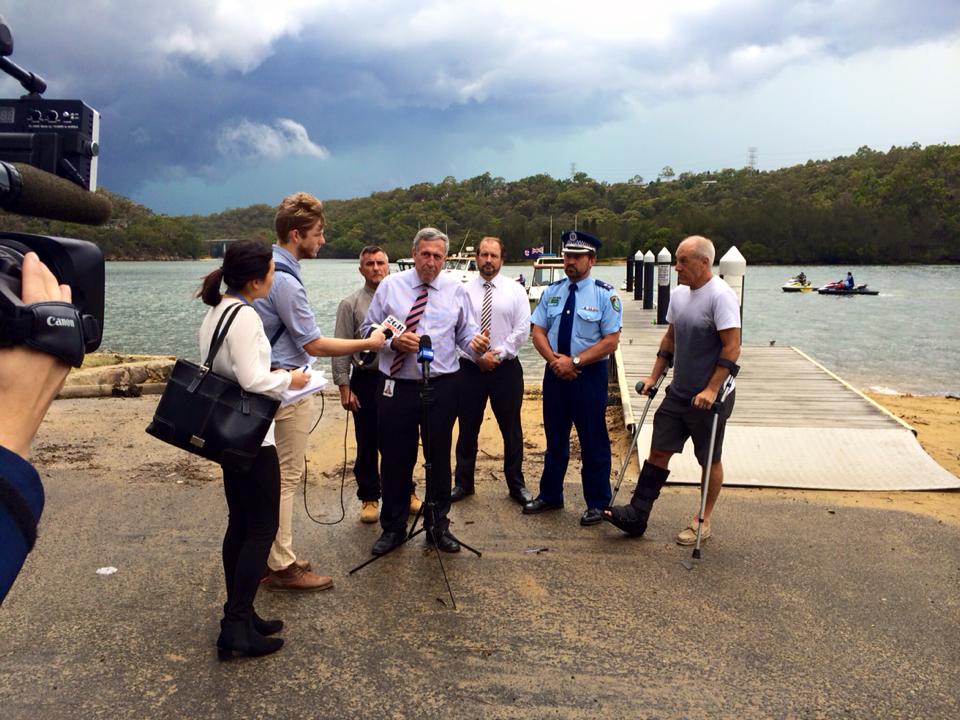
Lets do this before there are more of these meetings at the shore of were you ride!

maritime_crackdown
Director Maritime Angus Mitchell joins Minister for Roads, Maritime and Freight Duncan Gay and NSW Police Marine Area Commander Detective Superintendent Mark Hutchings to announce a crackdown on dangerous and anti-social riding of jetskis in and around the Georges River.
Media Release: Minister for Roads, Maritime and Freight Duncan Gay, Member for East Hills Glenn Brookes and NSW Police Marine Area Commander Detective Superintendent Mark Hutchings today announced a NSW Government crackdown on dangerous and anti-social riding of jet-skis in and around the Georges River, Botany Bay and Port Hacking.
New measures include increased high visibility and covert patrols, additional speed restrictions and jet-ski exclusion zones, stronger laws to enable immediate suspension of boat licences for reckless, dangerous and negligent behaviour and seizure and impoundment of jet-skis.
Minister Gay said local and boating community members had raised serious concerns about hoons who pose a huge safety risk to all river users.
“All jet-ski users flouting the law are on notice. We’re putting a stop to this behaviour,” Minister Gay said.
“Speed limits, irregular riding and safe distance rules are in place for a reason – breaking the law is just downright irresponsible and there are serious consequences.
“Everyone needs to share our waterways – there is no place for intimidating behaviour.
“Quite frankly, we shouldn’t have to stand up and tell jet-skiers to slow down, keep a safe distance and obey the law – it’s about time more courtesy and respect was shown for other boaters and water users.”
Detective Superintendent Mark Hutchings said it was known that dangerous hoon-like behaviour stopped when enforcement is in place, which is why we’re stepping it up a notch.
“Police officers will be tasked daily to patrol the Georges River and other areas where jet-skiers are causing trouble,” Det Supt Hutchings said.
“We are specifically targeting a rogue element of individuals who conduct illegal activities on the water. ”
“Police have already pressed charges against a man who allegedly drove his jet-ski negligently on the Georges River at Picnic Point, knocking a kayaker into the water and causing that man serious and painful injuries. ”
“We won’t hesitate to arrest and charge others who insist on breaking the law on the water,” he said.
Director of Maritime Angus Mitchell from Roads and Maritime Services said a raft of measures was also being considered to deter illegal activity and catch offenders, including the use of GPS and drone technology as well as increasing the number of CCTV cameras in and around problem areas.
“From 1 January, Roads and Maritime will extend the eight knot speed limit zone on the Georges River by two kilometres,” Mr Mitchell said.
“We’ve also set up a dedicated complaints hotline on 13 12 36 for the community to report incidents of dangerous or anti-social behaviour and compliance issues.”
The eight knot extension will apply from the downstream end of the existing four knot Picnic Point area about 1.5km, to near the entrance to Mill Creek. It will also extend the existing eight knot area upstream of the Picnic Point speed area about 500 metres to the entrance of Deadmans Creek, to include the Sandy Point boat ramp.
Mr Brookes said jet-ski exclusion zones would also be properly considered in parts of the Georges River (around Revesby), Port Hacking (Bonnie Vale) and Botany Bay over the next six months, in consultation with the local communities, water users and Police.
“These measures are a great win for the local community members who have been calling for tougher enforcement, so locals can use the waterways without feeling intimidated.
“Stronger laws to enable immediate suspension of boat licences for reckless, dangerous and negligent behaviour have already been proposed and new powers to enable seizure and impoundment of jet-skis will be progressed as part of marine safety legislation reforms in 2016.”
From OZPWC
 Image result for crashed sea doo

Boat Nut designed this program in 2015 and had it vetted by Yamaha, so here it is;


Application for this program click this link
Introduction to Personal Water Craft/ PWC - Personal Water Craft are versatile, fun and exhilarating craft, Boat Nut Media proficiency course prepares you for riding safely and responsibly and is designed for first time and experienced riders alike.
 
                                                          
OBJECTIVE: To be Self Sufficient in good conditions and aware of the limitations of yourself and your   PWC
Prerequisites: Valid Boat Operators Card
ASHORE KNOWLEGE:
Section 1:  Identify what is considered a PWC
1-      The candidate must be able to:
A-     Describe the primary difference between a power boat and a PWC
B-      Identify the difference between conventional propeller driven propulsion and jet propulsion
Section 2: Parts of the PWC and Terminology
The candidate must be able to:
1-      Identify and describe the following parts of a PWC
Bow                         Stern                                 Beam
Hull                          Keel                                   Freeboard
Bow Line                 Spring line                        Deck
Cleats                     Tow Eye                             Rub Rail
Foot Well                Locker                               Reverse door
Jet Intake              Jet Exhaust                         Steering Nozzle
Engine well            Tether                                Drain Plug
2-      Define the following terms
Aft                            Port                                   Starboard
Making Way           Ahead                               Draft
A stern                   Under Way                       Wash
Wake                       Leeway                             Forward
Section 3: The Engine and Propulsion Unit
The candidate must be able to:
3-      Identify the following parts used in the operation of a PWC
A-Common Engine Parts-
Engine cover               Battery                       Gear shift Lever
Throttle                        Brake                          Fuel Line
Fuel Tank                    Exhaust Outlet           Gauges
Air Filter                  Fluid Check Points        Warning Labels
Stuffing Box                 Steering                     Trim Controls
Water Intake Grate           Engine Bed         Engine Flush
4-        Name and describe the use of the following:
A: Fuel System- fuel filler, fuel tank, fuel line, fuel filter
B: Ignition System- start button, spark plugs, ignition wires
A-     Cooling System-water intake, heat exchanger, discharge
B-      Ignition Keys- learners key, full access key
5-      Describe how the jet propulsion works and the body of water levels required for safe operation and motor start up limitations
A-     Be aware of the depth of water the PWC is being operated in
B-      Be aware of the conditions of the body of waters bottom and depth before start up
C-      Be aware of the debris conditions of the body of water you are operating on
6-      Describe how to check and maintain the following:
Battery                     Cooling System Fluid               Engine Fluid Levels
Jet Water Pick Up         Control surfaces
7-      Describe probable causes and trouble shooting for the following situations:
A-     Engine is no start with no power at gauges
B-      Power at the gauges engine will not turn over
C-      Reduction of power and or alarm
D-     Engine difficult to start
E-      Engine stops suddenly
F-      Engine overheats
 

A-     Engine is running but PWC is not moving well
B-      No reverse
C-      No steering
D-     Pick up debris in jet intake
E-      Rope or debris around the jet propeller
F-      Water in fuel
1-      List the required steps to run or flush the engine out of the water
 
Section 4: Safety
The candidate must be able to:
2-      List from memory:
A-     Transport Canada required items for candidates PWC
B-      The rules for care for PFDs and life jackets
C-      The recommended method of testing buoyancy in a PFD
3-      Describe the importance of the Transport Canada information on the capacity plate
4-      Define what hypothermia is including:
A-     The signs and symptoms and the major areas of heat loss to the body
B-      Steps for prevention,
C-      Treatment for mild and severe hypothermia
D-     The actions to be taken by one or more individuals in cold water to increase survival time
5-      Define what cold shock is including:
A-     The signs and symptoms
B-      Steps for prevention
C-      Treatment for
6-      Define what carbon monoxide poisoning is including:
A-     The signs and symptoms
B-      Steps for prevention
C-       The treatment of
7-      Describe:
A-     The common source of fire and/or explosion on a power boat and methods of prevention
B-      The danger involved and the precautions to take when recharging batteries
8-      Describe as stated in the “ Safe Boating Guide”:
A-     Safe on the water refueling procedures
B-      The use of each of the types of flares their proper storage, and the method and safety precautions when using them
9-      The main responsibilities of the driver and passenger(s)
DRIVER
Safety of passengers and PWC
A-     Briefing on location and operation of lifesavings and other safety equipment prior to getting underway
B-      Instruction in the safe use of the PWC equipment while underway
C-      Obligations and observing an accident or vessel in distress
A-     Actions to demonstrate respect for other boaters and others property
              PASSENGER
A-     Obey the driver
1-      Describe:
A-     The reasons for keeping gear and equipment stowed in assigned places on a PWC and the principals for proper stowage of extra gear and equipment
B-      The frequency of maintenance of a PWC and its equipment so that it is capable of functioning at all times
C-      The minimum items recommended for a water proof emergency kit
Section 5: Seamanship
The candidate must be able to:
2-      Describe the use of the following:
Towing Bridle               Ski Tow Line
Boat Hook
3-      Describe the danger of a lee shore
4-      List some precautions that should be taken in preparation for heavy weather
5-      Describe the action to be taken in the following situations:
A-     Capsizing your PWC
B-      Collision with another boat
C-      Running aground
D-     Fouling the jet
E-      Engine failure
F-      Fire
G-     Springing a leak
H-     Steering fails
I-        Passenger falls off the PWC
J-       Beaching the PWC
Section 6: Weather
The candidate must be able to:
6-      List three sources of marine weather forecast
7-      Describe local weather hazards, the warning expected, and the identification of both the warning and the hazard.  Provide suitable action to be taken to reduce or avoid their effects
8-      Interpret the marine weather forecast applicable to the area of operation and apply that information:
A-     Determine whether it is safe to go boating
B-       Decide how forecast changes in the weather may influence the day’s planned activities
C-      Identify the wind speeds associated with:
Light winds                     Moderate winds                 Strong winds
Strong and warning         Gale warning                     Storm warning
Section7: Navigation

The candidate must be able to:
1-      Understand the use of a Canadian Hydrographic chart of the local are as follows:
DESCRIBE
A-     A chart
B-      Aids to navigation
READ
A-     Depth of water
B-      Distance scale
C-      Buoys and their significance
D-     Types of bottom ( sand, rock, mud, clay)
E-      Under water/surface hazards: kelp, cable, rock, shoals, cribs, currents
F-      Light symbols
G-     Beacons
2-      State the principals of operating a PWC around large boats
3-      Be able to orient yourself with where you are on the body of water you are using
Section 8- Boating regulations and rules of the road
The candidates must be able to:
4-      Describe any types of boating accidents which need to be reported and which authority is responsible
5-      Apply Collision Regulations Rules 13 to 21 by means of diagrams
6-      State the name, color and angle of visibility of lights required by:
A-     A vessel under power, under sail, under or giving a tow, and at anchor
B-      An unpowered vessel under 6 meters
7-      List six internationally recognized distress signals as stated in the “ Safe Boating Guide”
8-      Identify and describe the following:
PWC                                                     Pleasure Craft
Sailing vessel                                      Power driven vessel
Compliance/ Capacity Plate            Recommended gross load capacity
Recommended safe limit of engine power
9-      Demonstrate Knowledge of regulations applying to boaters
A-     Describe the process and guidelines for licensing a vessel and how a license number must be marked on a PWC
B-      Identify the principal acts/legislation that a PWC operator should be knowledgeable about, and the areas covered by each including
Small Vessel Regulations                                    The Criminal Code of Canada
 Collision Regulations                   Competency of Operators of Pleasure Craft Regulations
10-   Identify:
A-     Four considerations in determining the safe speed to operate a PWC
B-      The actions and precautions to be taken in reduced visibility
C-      Your responsibilities when operating in a commercial traffic lane
D-     The proper courtesies of operating in restricted passages and in harbors
Section 9: Complementary Water Sport Guidelines
The candidate must be able to:
1-      Describe the best techniques for the following:
A-     Driving while towing a water skier
B-      Returning a towline to a fallen skier
C-      Picking up a fallen skier
D-     Observing a skier
E-      Water and dock starts
2-      Describe the following water ski hand signals:
A-     Speed up or down
B-      Speed ok
C-      Head back
D-     Turn
E-      Stop
F-      I’m ok after a fall
3-      Identify the diving flags and appropriate PWC operation when in sight of such flags
Section 10- Trailering a PWC
The candidate must be able to:
4-      List the main criteria for selecting a trailer
5-      Describe the importance of load distribution between the trailer and the vehicles hitch
6-      Explain the fundamental skills needed to back a trailer attached to a vehicle
7-      List and demonstrate the main steps when launching and retrieving a PWC with a trailer or a PWC cart
8-      Describe how and why to pack the wheel bearings
9-      Describe the fundamentals  when using a PWC sling lift
 
 
AFLOAT SKILLS
Section 11: Preliminaries
The candidates must be able to:
1-      File a boating plan
2-      Demonstrate (on shore) the correct method of putting on a PFD while in the water
3-      Demonstrate the correct use of a heaving line
4-      Demonstrate how to belay a cleat (round turn, figure eight finish with a half hitch)
Section 12: Manoeuvering Under Power
The candidate must be able to:
 
5-      Plan and execute an undocking with varying wind and current conditions
6-      Manoeuver a PWC under varying sea and wind conditions, alongside and parallel to a dock, port to  and starboard to not more than two feet off without the aid of lines, without the stern passing a given mark at any time during the manoeuver
1-      Come to a full stop with bow one half PWC length away from a buoy using reverse( The objective of this manoeuver is to learn how much distance it takes to bring a PWC to a full stop, PWC is to be kept on a straight course while this manoeuver is being carried out)
2-      Demonstrate the driver’s actions from the time a passenger falls off the PWC until the passenger is recovered. Consider the passenger overboard wearing a PFD and available to assist him/her self      
A-     Maintain a look out
B-      Describe at least two methods of getting a person out of the water and back on the PWC
3-      Demonstrate the basic PWC handling
4-      Apply rules 5 through 18 of the Collision Regulations as applied to a PWC under power
5-      Demonstrate safe PWC operations at high and low speeds
6-      Demonstrate the ability to operate the PWC while focus is on collision avoidance
7-      Handling and recovery of driver back to PWC re board the PWC by yourself
Section 13: Making Fast and Snugging Down
The candidate must be able to:
8-      Secure a PWC to a dock so as to prevent excessive movement and set out fenders correctly
9-      Prepare a PWC for longer term mooring at a dock
10-   Describe the technique of placing a PWC on chocks, on a larger boat as a tender
 
Time Table                  4 hours     Classroom                    4 hours   On the Water
 
Like all other programs Boat Nut Media prepare a dry run to verify the time table.
 This Program may be used as a pre request for the International Certificate of Competence which is commonly required when operating your own or renting a personal water craft abroad.
Program Designed and Written by:   Clayton Cripps   Director of Education Development
                       Boat Nut Media   Toronto Ontario Canada    March 2015


To guarantee access to all of  Boat Nut Magazine articles, pictures and featured services visit the official Boat Nut Magazine ©™ website. Be sure to reply to the Boat Nut Association registration on our site for the latest Boat Nut weekly and monthly news letters and opportunities.


Copyright 2015 © Boat Nut Media, Toronto, Ontario. All rights reserved. No part of this information/publications may be stored in a retrieval system, transmitted, or reproduced in any way, including but not limited to photocopy, magnetic, or other record, without prior agreement and written permission of the publisher, Boat Nuts Media ©™ No liability is assumed with respect to the information provided